
Control NAS Capacity: Reduce Costs & Extend Lifespan with Data Lifecycle Management

What decision-makers should know
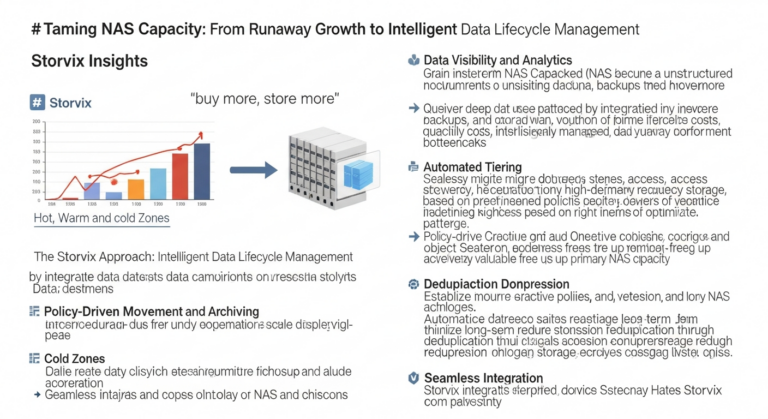
Most mid-market IT teams and MSPs are wrestling with runaway NAS capacity: steadily growing file volumes, unpredictable spike events, and an accumulation of cold data that eats usable space and drives premature refreshes. The operational problem isn’t a single failed array — it’s inefficient capacity economics. We overbuy to avoid running out, we carry stranded or poorly tiered capacity, and we pay in complexity and capital when refresh time comes.
Traditional approaches — buy bigger controllers, bolt on scale-out boxes, or move everything to a one-size cloud bucket — fail because they treat capacity as a hardware procurement problem instead of a data lifecycle problem. Those options increase OPEX/CAPEX, fragment management, or push risk to the cloud without giving the lifecycle controls needed for compliance, chargeback, or predictable margins. The strategic shift is toward intelligent data platforms like STORViX that focus on capacity governance: analytics-driven classification, policy-based tiering, efficient reclamation, and cross-array control. That approach turns NAS capacity from a guessing game into a managed lifecycle, lowering cost per usable TB, reducing refresh frequency, and restoring operational control.
Do you have more questions regarding this topic?
Fill in the form, and we will try to help solving it.


