
Control Google Cloud Backup Costs: Intelligent Data Lifecycle Management with STORViX

Control Google Cloud Backup Costs: Intelligent Data Lifecycle Management with STORViX

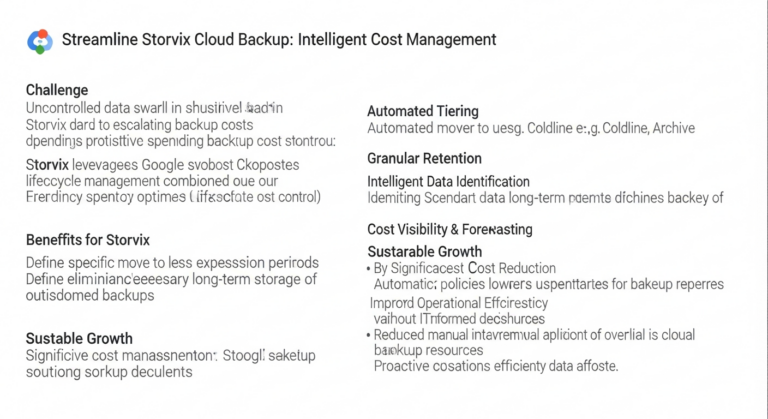
What decision-makers should know

  • Financial impact: Proper lifecycle and placement can materially reduce long-term backup spend — by eliminating unnecessary nearline/standard storage and avoiding repeated egress charges during restores.
  • Risk reduction: Enforce immutability, retention and multi-region copies consistently so backups are actually recoverable after ransomware or site failure, not just sitting as a bill line.
  • Lifecycle benefits: Automate tiering (Standard → Nearline → Coldline → Archive) and retention, so data ages into the most cost-effective class without manual intervention or risky ad-hoc scripts.
  • Compliance control: Centralize retention proof, immutability windows, CMEK/KMS usage and immutable snapshots for audits — without juggling spreadsheets or vendor-specific add-ons.
  • Operational simplicity: Single policy engine that integrates with Google Cloud eliminates per-job tweaking, reduces ticket churn, and gives predictable capacity forecasts and billing views for MSP margins.
  • Restore-cost management: Keep recent restore targets in lower-latency/low-egress zones and use staged restores to avoid surprise egress or retrieval fees during DR testing.
  • Margin protection for MSPs: Convert opaque consumption into billable, traceable services with usage reporting, client-level quotas and predictable pricing rather than absorbing spikes.

Many mid-market IT teams and MSPs are squeezed by rising infrastructure costs, shrinking margins, and compliance mandates — and Google Cloud backup storage often becomes the runaway line item nobody fully understands. Teams move backups to GCP because it looks cheaper than buying new arrays, but without lifecycle controls, dedupe and policy automation you end up paying for the wrong tier, incurring egress and API charges, and keeping stale data longer than regulations (or auditors) allow.

Traditional approaches — lift-and-shift backup sets to cloud buckets or relying on backup software to guess storage classes — fail because they treat cloud as just another disk. That creates unpredictable bills, restores that trigger high egress costs, and an operational burden to police retention and immutability manually. The smarter move is an intelligent data platform like STORViX: a control plane that enforces lifecycle policies, optimizes placement across Google Cloud storage classes, enforces compliance primitives (immutability, retention, KMS control), and converts backup sprawl into predictable TCO. In short: stop treating cloud as a dumb archive and start managing backup data as a lifecycle asset under your control.

Do you have more questions regarding this topic?
Fill in the form, and we will try to help solving it.

Contact Form Default